
Very foggy weather at the Vancouver International Airport did not delay my early morning flight to Houston. After climbing through clouds for several minutes, the plane rose above the fog and I spied a little piece of the Lower Mainland peeking through. I now have seven hours to while away writing to you from the George Bush Intercontinental Airport until my next flight to Buenos Aires. This delay also provides me with ample opportunity to dote over the newly hatched, brown, fuzzy Adélie penguins on Torgersen Island – a little south of where I will likely be – and their parents. You too can indulge your inner softy here: http://www.usap.gov/videoclipsandmaps/palwebcam.cfm
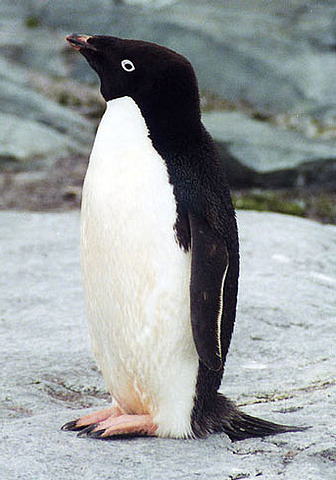
There are 17 species of penguins, but only four inhabit the Antarctic region. The Adélie penguin is named for the wife of the French explorer Jules Dumont d’Urville who discovered them in the mid-1840s. They are black and white with little other colouring. These penguins grow to 46 cm to 71 cm (18 in to 28 in) in height. Adélies live only in the Antarctic region.
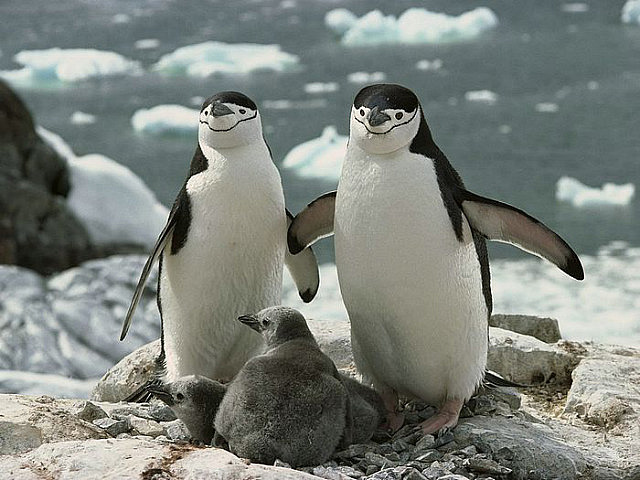
My favourite – because I think it is the cutest – is the Chinstrap penguin named for obvious reasons though I think the strap looks more like a smile. This penguin too is only black and white, and about the same size as the Adélie penguin.
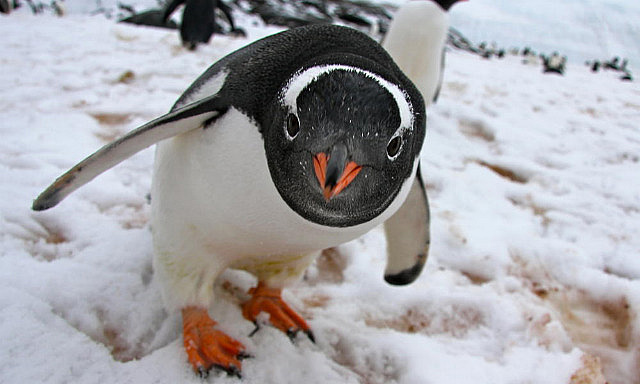
The Gentoo penguin has a bright orange bill and a white ring across its forehead. Gentoos are larger than Adélies and Chinstraps, and will grow to 51 cm to 90 cm (20 in to 35 in). They inhabit a wide range on and around Antarctica and can even be spotted in Tierra del Fuego, South America.
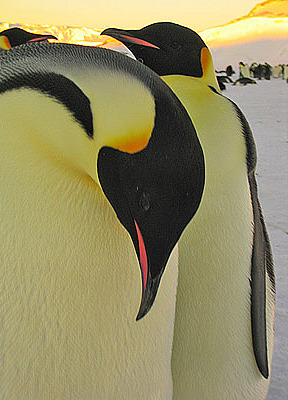
The fourth species, and the one most people envision when they think of penguins, is the Emperor. These are the most dramatic in appearance and the largest of the Antarctic penguins, growing to 122 cm (48 in). The white feathers below the head are gold, gradually fading to white along the chest. The Academy award winning documentary March of the Penguins is about the heroic breeding practices of the Emperor. If you have not seen this film, you can find a taste of it here: http://www.warnerbros.com/march-penguins
I will probably encounter Adélies, Chinstraps and Gentoos, but the Emperors usually breed to the south of the area I will visit. Recent research however suggests that there are a couple of colonies in the Antarctic Peninsula – the smart ones, it’s not as cold further north! I will keep my eyes peeled for these exotic birds.
Next stop – Buenos Aires!


Leave a Reply