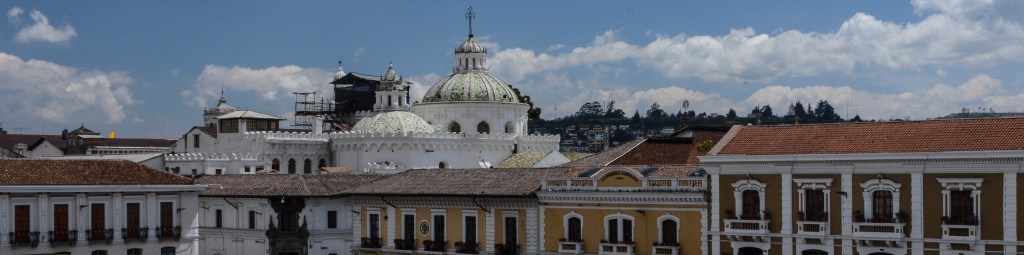
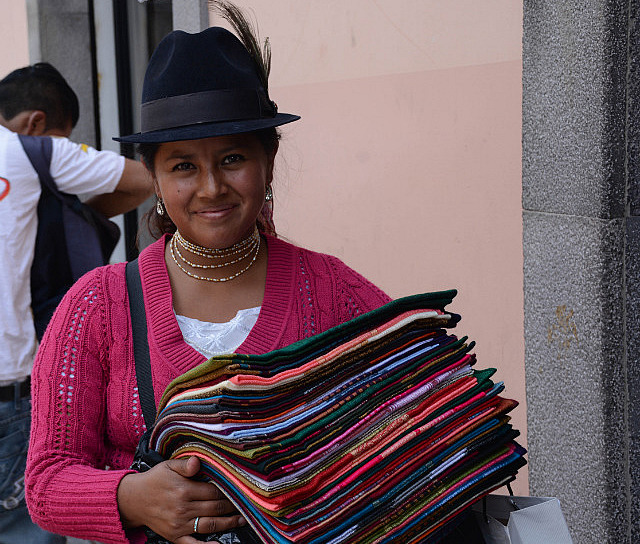
I hardly know where to begin. Perhaps with I heart Ecuador! What a day we have had.
First thing this morning Road Scholar group leader, Gonzalo Gavilanes, who is smart and funny and full of knowledge about Ecuador, introduced us to Ecuadoran culture and economy. Tour guiding is a profession here, and one qualifies for it after a five-year university program that is essentially a liberal arts degree with a major in everything Ecuadoran combined with organizational skills and human resource management. There are eleven other people on my tour, five couples and another singleton female, all American and happy to be escaping the latest polar vortex affecting their homes. The majority are retired teachers – high school and university – though we have a couple of doctors and a university veterinarian with us as well.
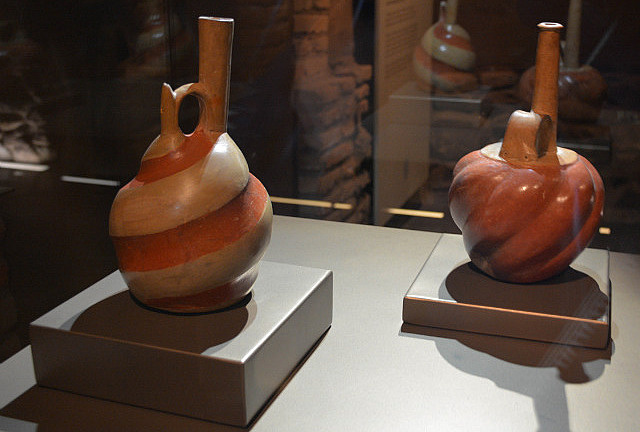
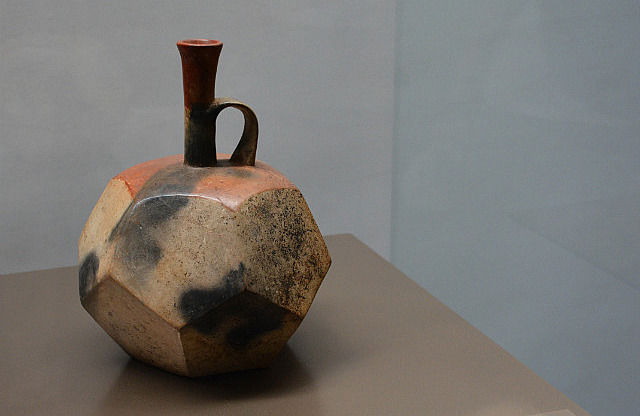
The day once again was sunny and balmy – the last time I believe a weather forecast! We toured Museo Casa del Alabado in old Quito, an historical museum built around a lovely courtyard with a collection organized according to Andean cosmology. Courtyards are important in Ecuadoran architecture for protection from the noise of a busy city outside the walls, and as a social meeting place. Traditionally enclosed rooms were reserved for the women, and non-family men were not invited in. I was particularly impressed by a few of the fine teapots in the collection. They are examples of very early ceramics, two of the teapots dating back to 950 BC, and the other to 350 AD. The latter is shaped in a perfect pentagon, not easy to create without advanced technology.
After the Museo Casa del Alabado, we toured La Compania, a Jesuit church, and San Francisco Catholic Church and Convent. Photos cannot be taken inside, so picture two full-size cathedrals virtually wall-papered with gold and gold filigree work. I am including stock photos of the interior of La Compania and the altar of San Francisco Church. They were quite breathtaking.
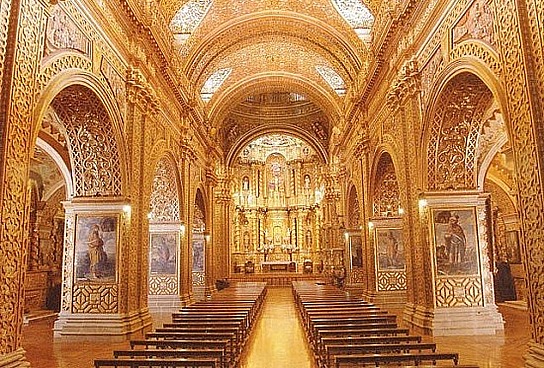
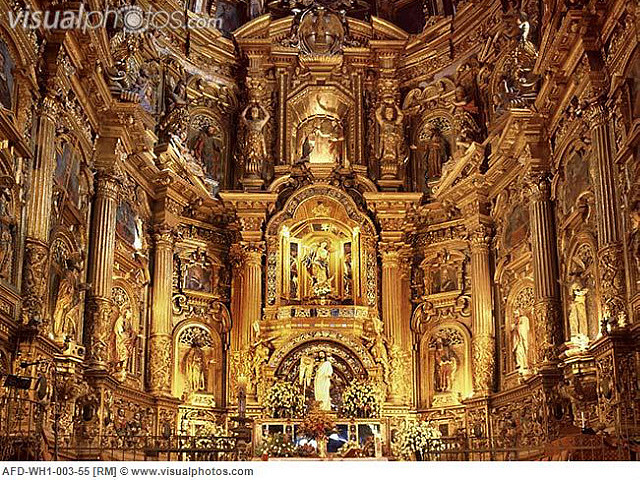
Ecuadoran Indians were not allowed in churches until the mid-1800s. When they were finally recognized as human beings with souls, the church had to make itself meaningful to them. Ecuadoran Catholicism has thus evolved to include indigenous beliefs in its artwork and practice.
Lunch was something altogether different! We were offered a choice of various starters and main courses. I went ethnic Ecuadoran and chose quinoa soup (yes Gillian!) and a quite delicious lamb stew complete with a – OMG so good! – diet Coke! I felt quite virtuous as both our doctors also ordered diet Cokes.
Dessert was when the fun began. For some reason (I missed that part) waiters dress up, one as a monk, the other as a penitent in a bright purple KKK-esque hood and gown – the lights are dimmed and chimes announce the ceremony. The two servers deliver ice cream in bowls perched in larger bowls of dry ice.
In spite of the gold filigree and the dry-ice ice cream, today’s highlight was a visit to the Capilla del Hombre, a museum designed by Oswaldo Guayasamin (1919-1999), one of Ecuador’s most loved artists. The building houses some of his collection, though a lot of it is in private hands the world over.
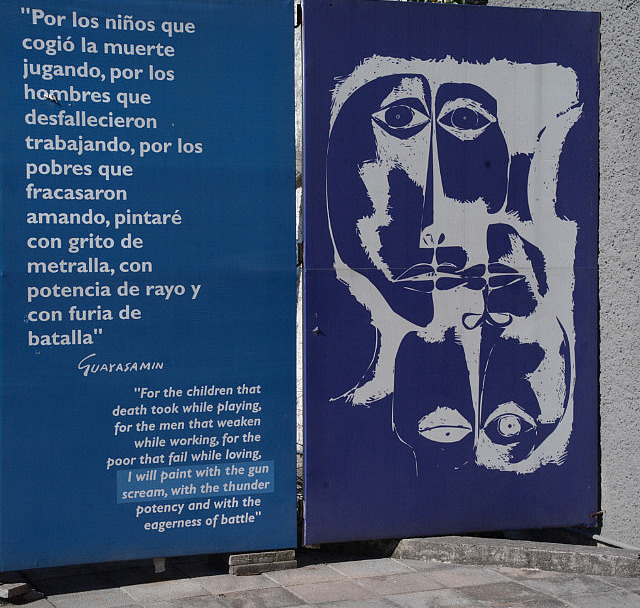
Guayasamin’s work portrays the plight of the Latin American people, from the suffering imposed by cruel dictators to the civil wars to overarching poverty. Towards the end of his life, he created a series of pictures dedicated to his mother – his tenderness series. Guayasamin painted during a period of cubism and his style certainly didn’t appeal to everyone in our group. One of my tour mates thought his art a poor homage to Picasso, but I felt it speaking to me. It was tremendously moving and captured so clearly the pain, the frustration and the devastation faced by so many Ecuadoran people in the second half of the 20th century.
Once again, we were not allowed to take photos but this link will take you to a virtual tour of Capilla del Hombre. Click on the arrow by the door to enter the building. The series of nine faces just inside the door must be seen to be fully appreciated.
http://www.qpqweb.com/index.php?option=com_content&view=category&layout=blog&id=69&Itemid=179.
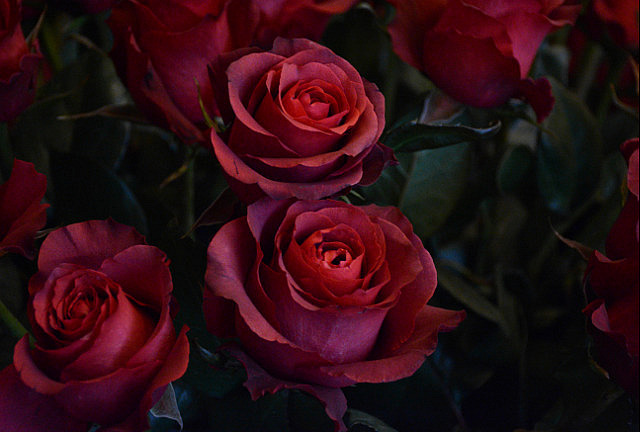 Fortunately, Ecuador has made great economic progress, especially in the 21st century. She is a social democratic country with an income gap smaller than her neighbours, with universal health care and compulsory public education, with a keen awareness of the richness of her environment and a determination to protect it. The one anomaly is her exploitation of the oil that was discovered in the 1970s; however the revenues of this state-owned industry help pay for the public services that are lifting her people out of poverty. Ecuador’s other main exports are bananas, cocao, shrimp which are farmed in mostly dry-land pens, and utterly perfect roses grown in greenhouses the year round. Oh, and Ecuador is one of the few Catholic countries in the world that still exports priests.
Tomorrow the jungle! Ven conmigo en esta nueva aventura.


Leave a Reply