
On the Move

Wat-ting and Shadowing
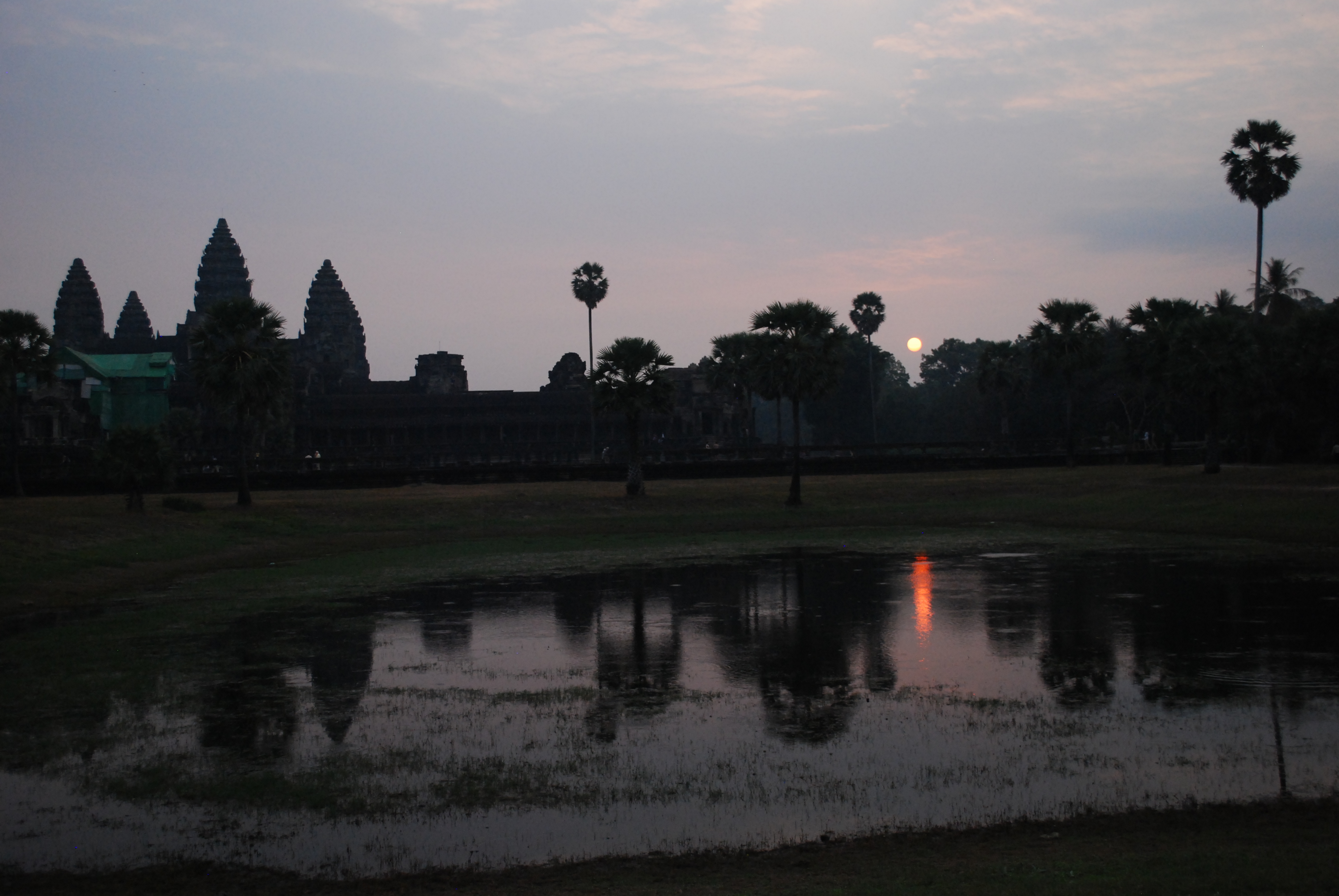
Watching the sun rise at Angkor Wat

What a day!  Angkor Wat at dawn and shadow puppets at dusk, with local school children and artisans in between.

We arrived at Angkor Wat along with about 10,000 of our closest friends at 6:00 am for a 6:45 sunrise and parked ourselves on the slope of a reflecting pond.  On perfect mornings the sky turns pink and gold behind the temple’s towers, but today wasn’t perfect.  The sky was overcast so we didn’t get the dramatic light, but there was still something magical about being at this enormous temple at dawn.  Our local guide Bros assured us that once the sun was up most of the tourists would leave and we would be able to explore relatively uninterrupted.  He was right.

Angkor Wat is truly amazing.  It is one of the five great historical structures of the world along with the Coliseum in Rome, Petra in Jordan, the Pyramids in Egypt and the Great Wall of China.  It is in great disrepair though I wouldn’t call it a ruin; looting and atmospheric erosion have both taken their toll. The temple is built primarily of sandstone, again of large stones piled one on the other with no mortar or cement.  There is a marked difference between Ta Prohm and Bayon, for example, and Angkor Wat in the quality of the craftsmanship.
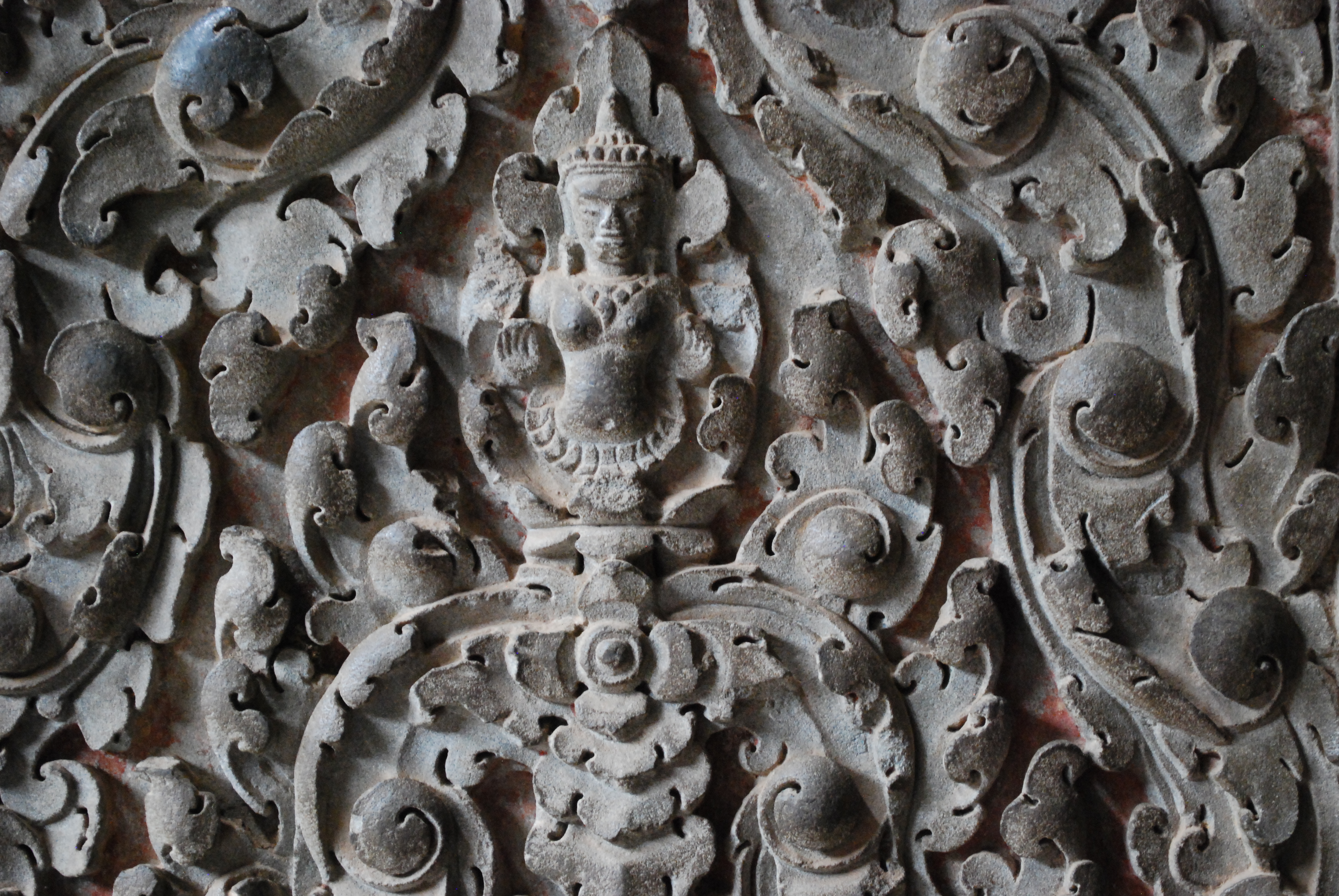
Bas relief carving detail

Ta Prohm and Bayon were commissioned by King Jayavarman VII (1181-c.1220) who built a lot of temples while Angkor Wat was built by King Suryavarman II (1113-c.1150) who commissioned fewer but commanded better quality.  It is often quite difficult to find the seams between the stones and the carving is exceptional.  About 3 km of wall are decorated in bas relief murals of wars and life, and nowhere in the entire collection of carvings are there duplicates.
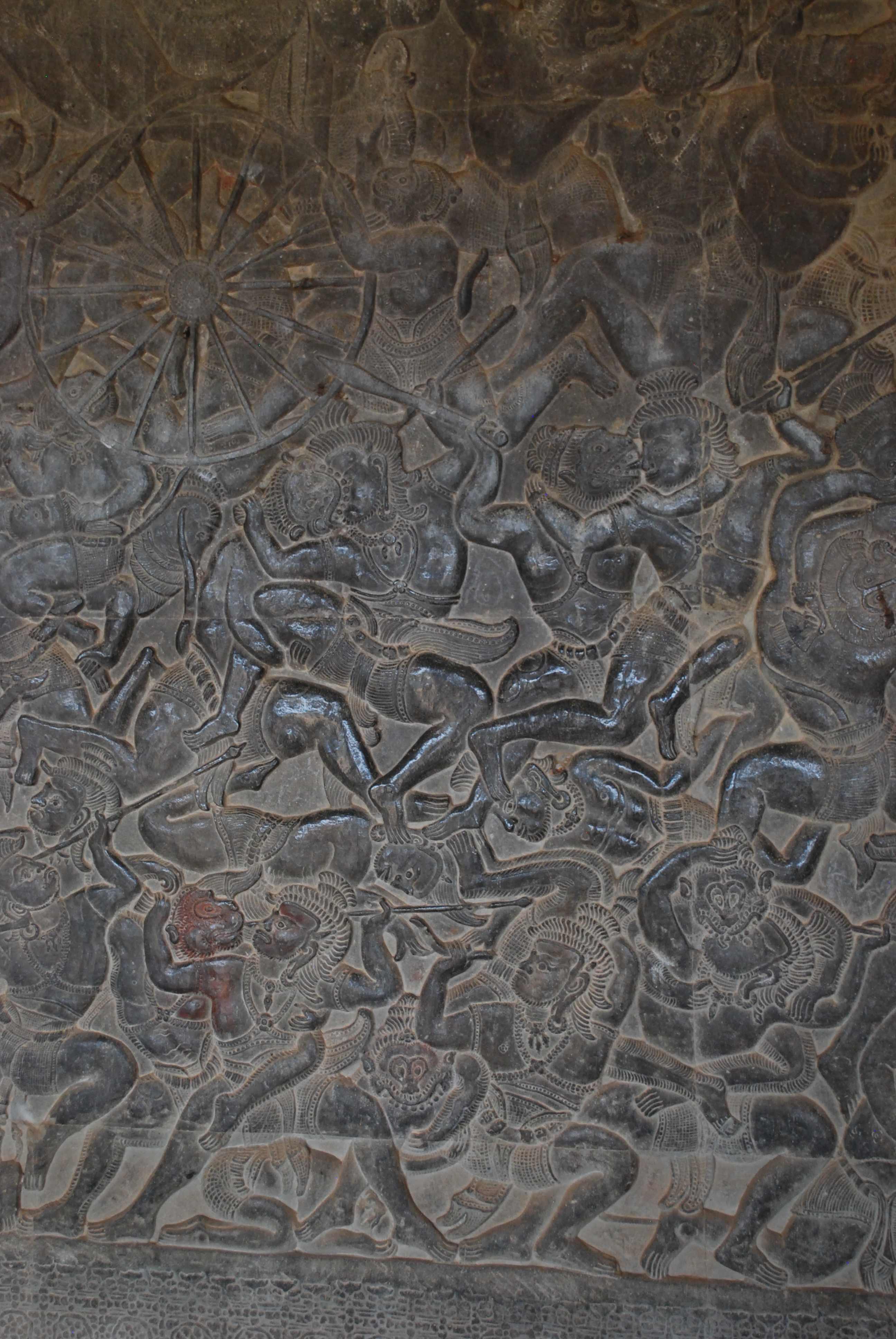
Find the break between the stones
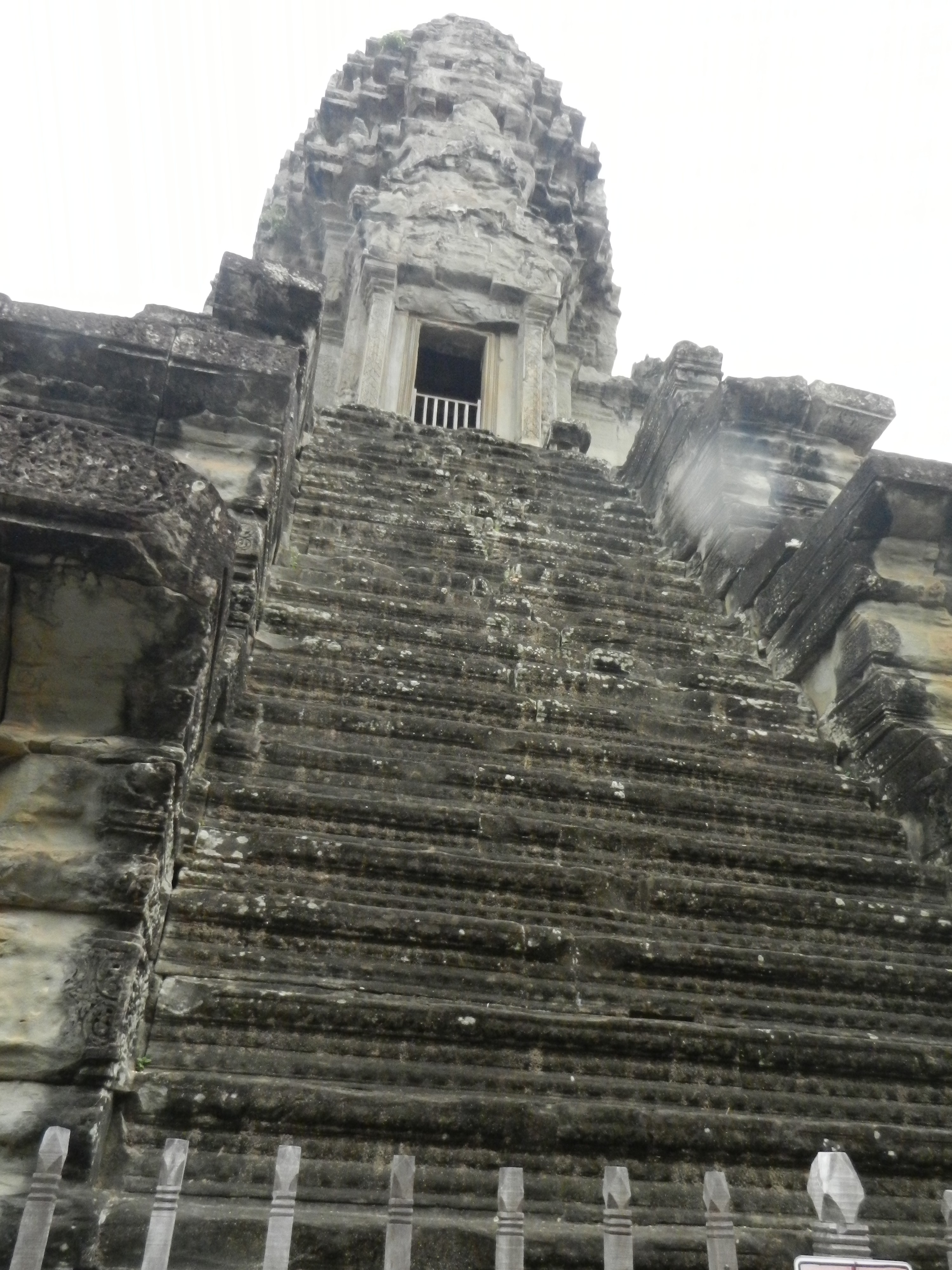
Original steep stairs leading to third level

Angkor Wat also differs from the other temples in that the inner sanctum is elevated; this signifies that it was built for royalty.  The first level is composed of a large courtyard with covered hallways around the perimeter.  The second level is a smaller version of the first.  The third was once accessible only by very steep stone stairs which are now closed off, and only the highest level temple dignitaries and royalty were allowed in the topmost area.  Tourists can climb to the third level but must use proper stairs.
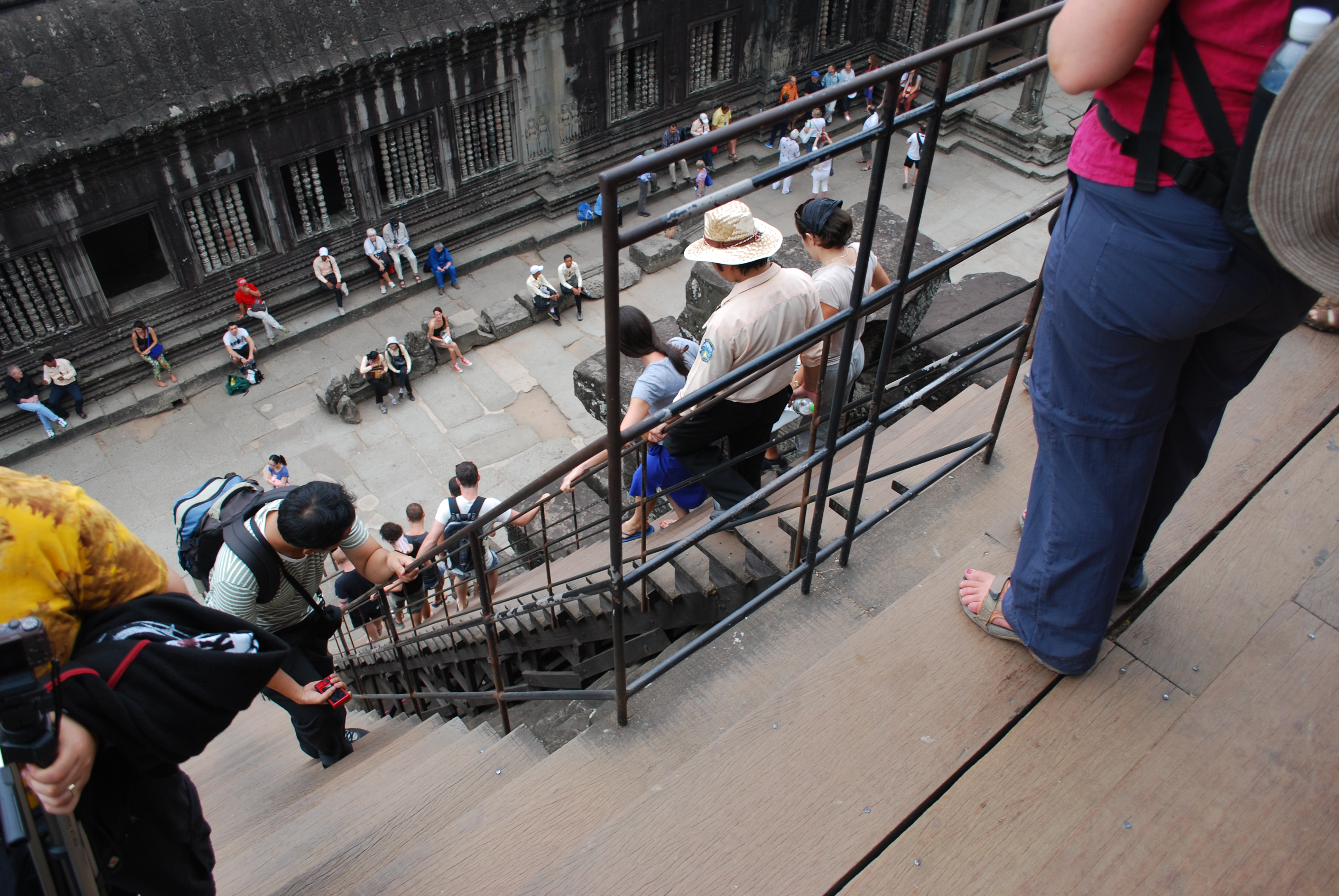
Steep stairs for tourists

Hindu images are everywhere in this temple.  The outer tower tops were once decorated with statues of Vishnu and other Hindu deities but are now virtually unrecognizable due to erosion.  There are walls covered with Sanskrit text.  And of course Buddha was a reincarnation of Vishnu, so even when Buddha images show up they reflect Hindu beliefs.
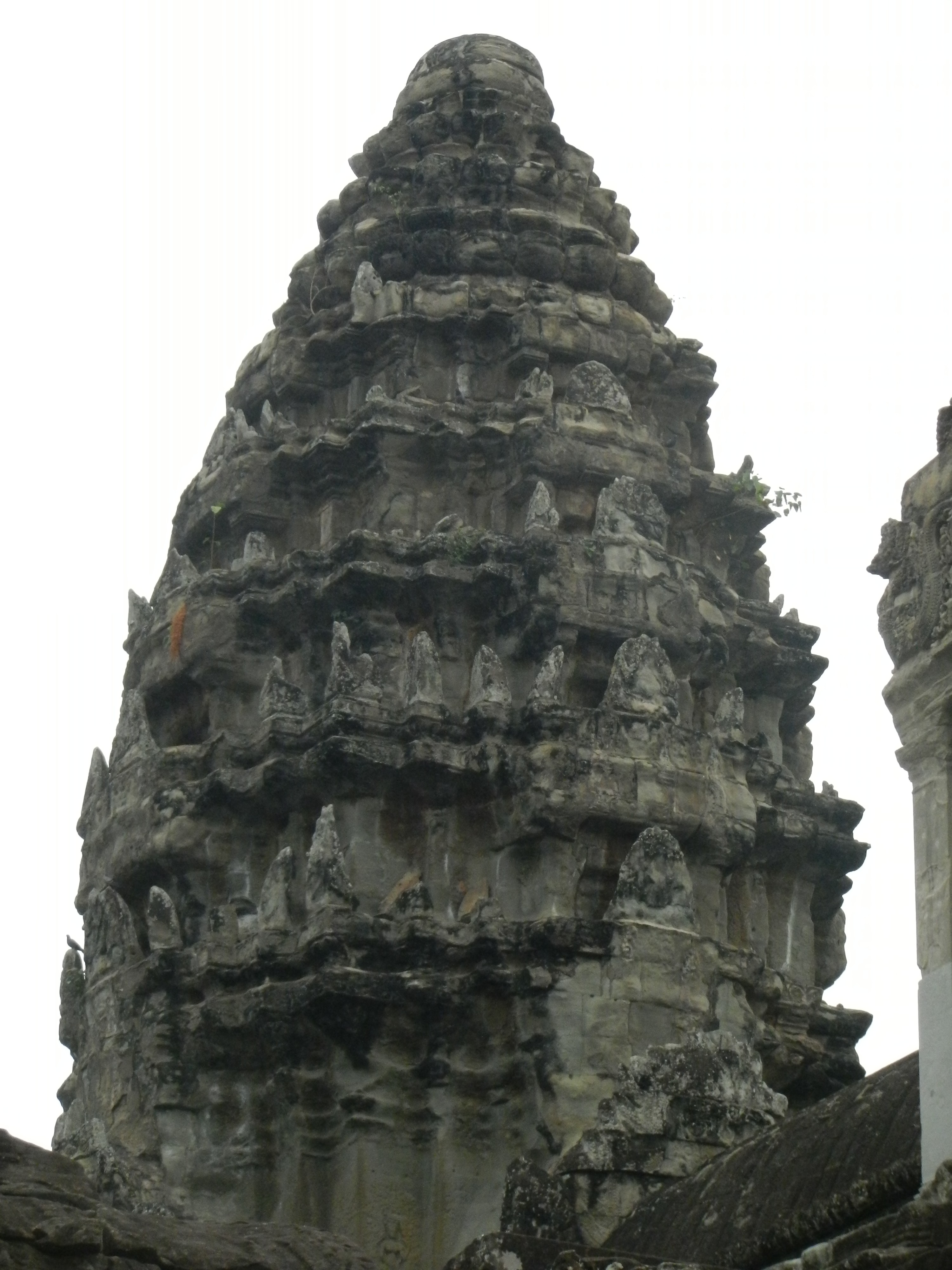
Top of main tower with eroded statues

After a couple of hours exploring we had breakfast at The Blue Pumpkin across from Angkor Wat. Fried eggs, bacon, sausage, bread, yogurt with fruit, OJ, coffee or tea was the set menu, not the usual traditional Cambodian breakfast!  We then visited the Spitler Primary School just outside Siem Reap.  Danny Spitler of Phoenix, about a dozen or so years ago, was traveling in Cambodia.  His guide was telling him about life under the Khmer Rouge and how the country was yet to recover.

Two little boys at the Spitler School

Healthcare was spotty, clean water scarce and primary schooling almost non-existent.  The guide estimated that it would take about $700 to start a school, so Mr. Spitler took it on.  His project (spitlerschool.org) has evolved into a charitable foundation that now supports two schools. Most of the work of the school is educating children, but another part is training teachers.  Pol Pot and his regime eliminated the intellectual class leaving a void where home-grown Cambodian mentors and leaders should be.  The Foundation matches the government’s salaries for teachers which helps the school attract and retain good people.  Road Scholar supports the school by bringing supplies with each tour.  There was a clear difference between the lively cheerful children at this school and the sombre, beaten-down-looking children who hawk souvenirs at tourist locations.
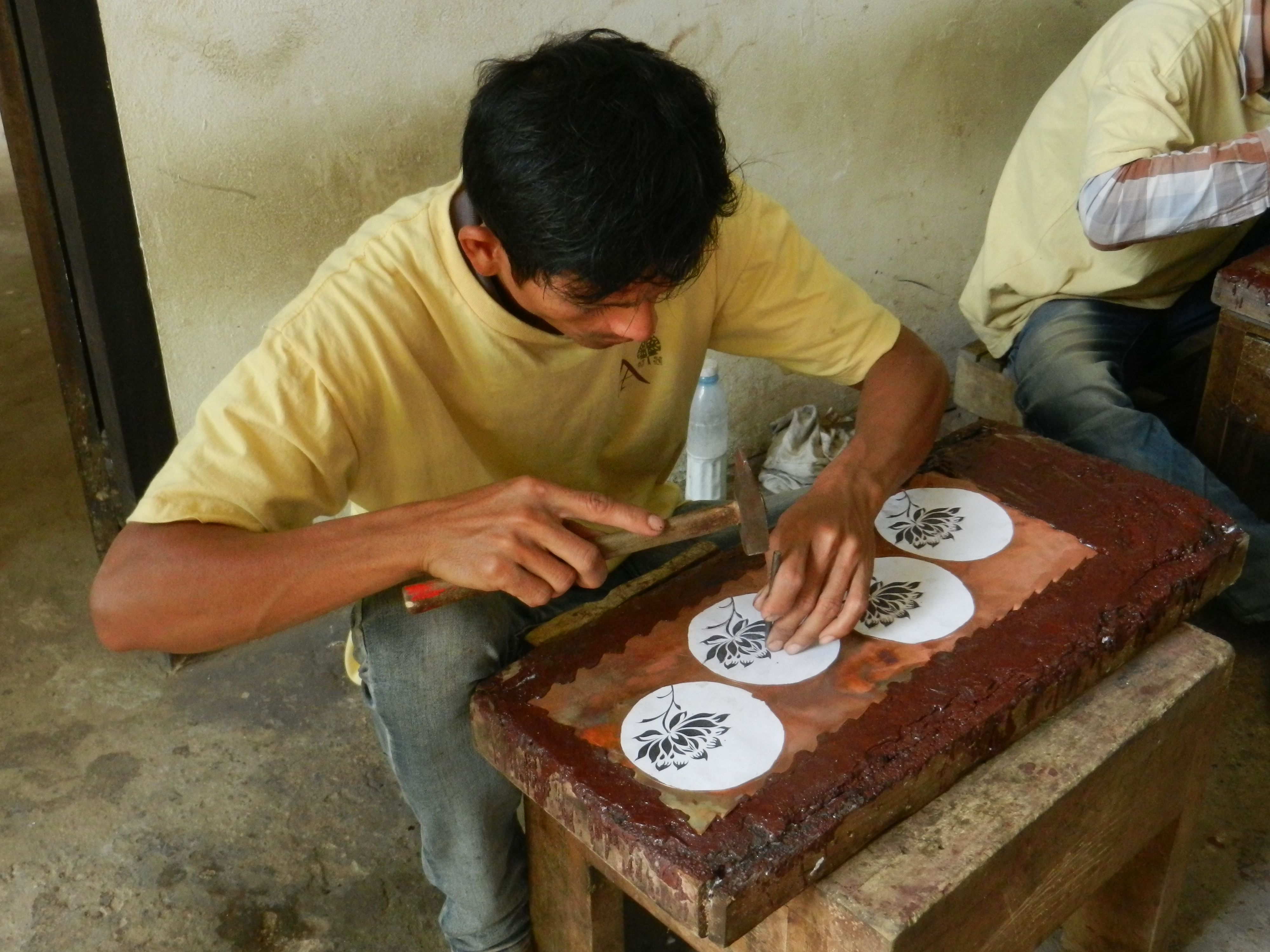
At Artisans Angkor
At Artisans Angkor

This afternoon we toured Artisans Angkor, a school aimed at recovering and rejuvenating the traditional Cambodian arts of weaving, silver work, silk paintings and carvings.  Once again, during the Pol Pot regime many of the masters of these crafts were killed and there was a concern that these traditions would die out.  This school trains artists from all over Cambodia and especially artists who are disabled.  I am proud to say that I did my part today in supporting the Cambodian economy and its artisans by purchasing a silk painting of a village woman.  You can see the upper part of it in the web page header here:  artisansdangkor.com/shop/en/28-silk-painting

To continue with the theme of the decimation of Cambodia’s educated class by Pol Pot, we watched The Flute Player about a boy, Arn Chorn Pond, who escaped from the army, crossed the border with Thailand and was adopted by an American.  He has now dedicated his life to exposing the atrocities of the Khmer Rouge and running a program in Cambodia that teaches young people traditional music – song, dance, and the playing of traditional musical instruments.
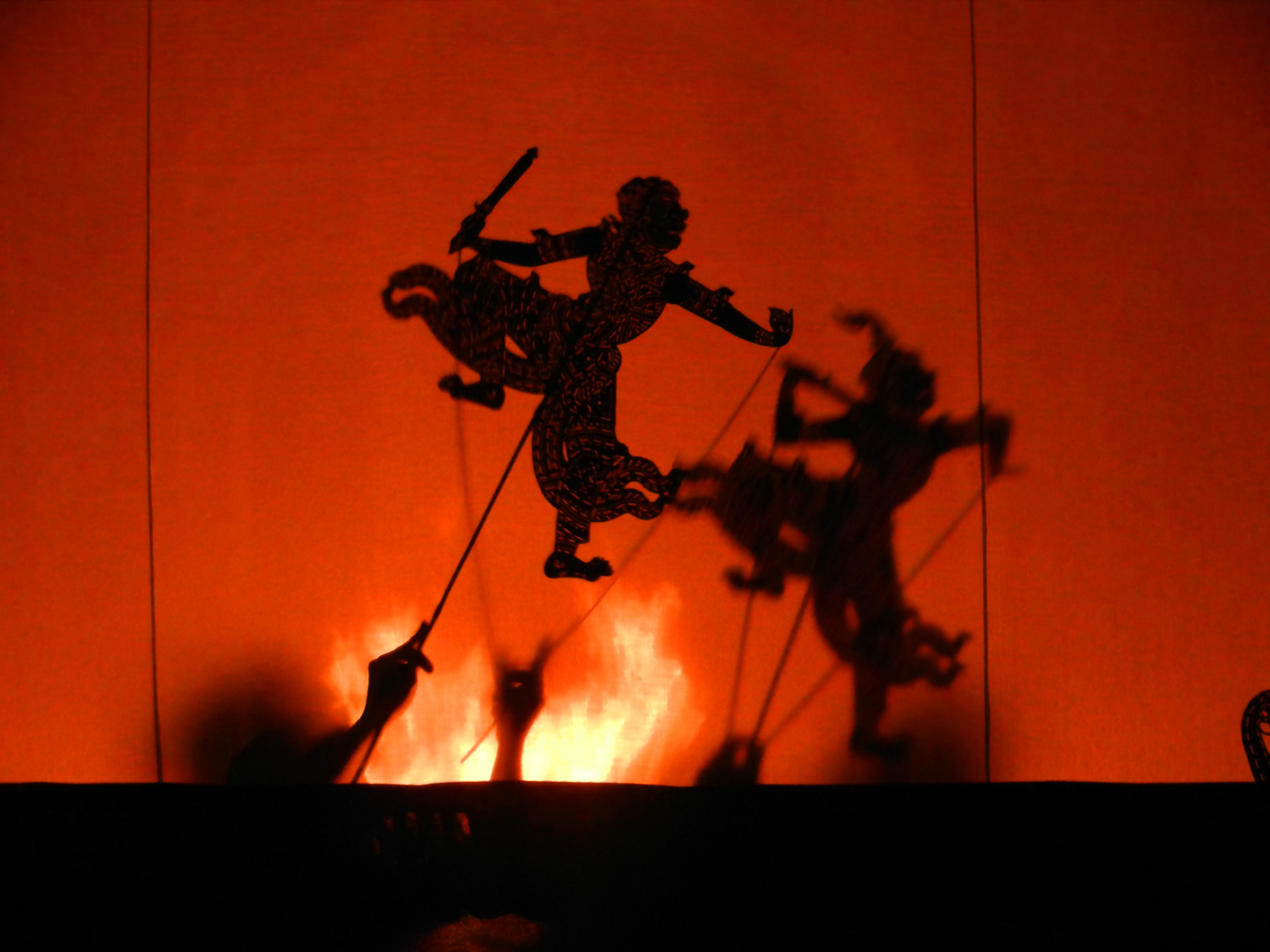
Two shadow puppets duelling

After dinner at another excellent French-owned restaurant – I had no idea Siem Reap had such an elegant and sophisticated dining scene! – we were treated to a shadow puppet show put on by artists who have learned their trade through Arn Chorn Pond’s efforts.  The story was a simple Ramayana tale, the same story told by the Laotian ballet.  We of course couldn’t understand what the puppets were saying, but they were nevertheless amusing.  Musicians playing traditional instruments sat to one side of the stage.  Their music attracted a few locals who clearly thought the show funny.

https://www.flickr.com/photos/64513024@N07/21142050771/in/datetaken/

Leave a Reply

Watching the sun rise at Angkor Wat

What a day!  Angkor Wat at dawn and shadow puppets at dusk, with local school children and artisans in between.

We arrived at Angkor Wat along with about 10,000 of our closest friends at 6:00 am for a 6:45 sunrise and parked ourselves on the slope of a reflecting pond.  On perfect mornings the sky turns pink and gold behind the temple’s towers, but today wasn’t perfect.  The sky was overcast so we didn’t get the dramatic light, but there was still something magical about being at this enormous temple at dawn.  Our local guide Bros assured us that once the sun was up most of the tourists would leave and we would be able to explore relatively uninterrupted.  He was right.

Angkor Wat is truly amazing.  It is one of the five great historical structures of the world along with the Coliseum in Rome, Petra in Jordan, the Pyramids in Egypt and the Great Wall of China.  It is in great disrepair though I wouldn’t call it a ruin; looting and atmospheric erosion have both taken their toll. The temple is built primarily of sandstone, again of large stones piled one on the other with no mortar or cement.  There is a marked difference between Ta Prohm and Bayon, for example, and Angkor Wat in the quality of the craftsmanship.

Bas relief carving detail

Ta Prohm and Bayon were commissioned by King Jayavarman VII (1181-c.1220) who built a lot of temples while Angkor Wat was built by King Suryavarman II (1113-c.1150) who commissioned fewer but commanded better quality.  It is often quite difficult to find the seams between the stones and the carving is exceptional.  About 3 km of wall are decorated in bas relief murals of wars and life, and nowhere in the entire collection of carvings are there duplicates.

Find the break between the stones
Original steep stairs leading to third level

Angkor Wat also differs from the other temples in that the inner sanctum is elevated; this signifies that it was built for royalty.  The first level is composed of a large courtyard with covered hallways around the perimeter.  The second level is a smaller version of the first.  The third was once accessible only by very steep stone stairs which are now closed off, and only the highest level temple dignitaries and royalty were allowed in the topmost area.  Tourists can climb to the third level but must use proper stairs.

Steep stairs for tourists

Hindu images are everywhere in this temple.  The outer tower tops were once decorated with statues of Vishnu and other Hindu deities but are now virtually unrecognizable due to erosion.  There are walls covered with Sanskrit text.  And of course Buddha was a reincarnation of Vishnu, so even when Buddha images show up they reflect Hindu beliefs.

Top of main tower with eroded statues

After a couple of hours exploring we had breakfast at The Blue Pumpkin across from Angkor Wat. Fried eggs, bacon, sausage, bread, yogurt with fruit, OJ, coffee or tea was the set menu, not the usual traditional Cambodian breakfast!  We then visited the Spitler Primary School just outside Siem Reap.  Danny Spitler of Phoenix, about a dozen or so years ago, was traveling in Cambodia.  His guide was telling him about life under the Khmer Rouge and how the country was yet to recover.

Two little boys at the Spitler School

Healthcare was spotty, clean water scarce and primary schooling almost non-existent.  The guide estimated that it would take about $700 to start a school, so Mr. Spitler took it on.  His project (spitlerschool.org) has evolved into a charitable foundation that now supports two schools. Most of the work of the school is educating children, but another part is training teachers.  Pol Pot and his regime eliminated the intellectual class leaving a void where home-grown Cambodian mentors and leaders should be.  The Foundation matches the government’s salaries for teachers which helps the school attract and retain good people.  Road Scholar supports the school by bringing supplies with each tour.  There was a clear difference between the lively cheerful children at this school and the sombre, beaten-down-looking children who hawk souvenirs at tourist locations.

At Artisans Angkor
At Artisans Angkor

This afternoon we toured Artisans Angkor, a school aimed at recovering and rejuvenating the traditional Cambodian arts of weaving, silver work, silk paintings and carvings.  Once again, during the Pol Pot regime many of the masters of these crafts were killed and there was a concern that these traditions would die out.  This school trains artists from all over Cambodia and especially artists who are disabled.  I am proud to say that I did my part today in supporting the Cambodian economy and its artisans by purchasing a silk painting of a village woman.  You can see the upper part of it in the web page header here:  artisansdangkor.com/shop/en/28-silk-painting

To continue with the theme of the decimation of Cambodia’s educated class by Pol Pot, we watched The Flute Player about a boy, Arn Chorn Pond, who escaped from the army, crossed the border with Thailand and was adopted by an American.  He has now dedicated his life to exposing the atrocities of the Khmer Rouge and running a program in Cambodia that teaches young people traditional music – song, dance, and the playing of traditional musical instruments.

Two shadow puppets duelling

After dinner at another excellent French-owned restaurant – I had no idea Siem Reap had such an elegant and sophisticated dining scene! – we were treated to a shadow puppet show put on by artists who have learned their trade through Arn Chorn Pond’s efforts.  The story was a simple Ramayana tale, the same story told by the Laotian ballet.  We of course couldn’t understand what the puppets were saying, but they were nevertheless amusing.  Musicians playing traditional instruments sat to one side of the stage.  Their music attracted a few locals who clearly thought the show funny.

https://www.flickr.com/photos/64513024@N07/21142050771/in/datetaken/